Read at road speed
One dominant name. One contact zone. Nothing competes with the call to action.
Research-driven concept · Montréal 2026
Commercial visual branding
A practical concept for a Montréal studio that turns service vehicles into consistent, high-performing brand assets.
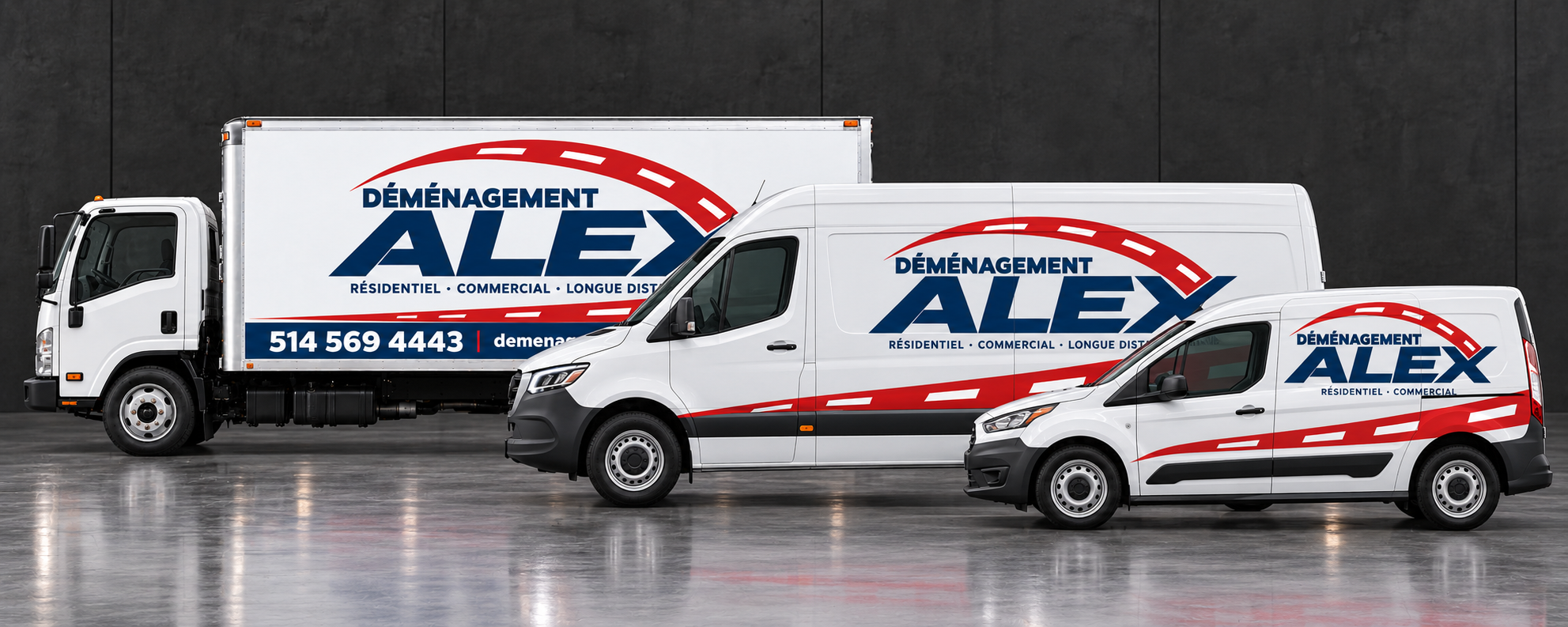
The market standard
Montréal clients do not buy a roll of vinyl. They buy one reliable outcome — a vehicle that looks considered, prints correctly and arrives ready to work.
Vehicle graphics are read in seconds — often from across a street or a moving lane.
The design establishes a clear hierarchy: brand first, service second, contact details third. Then that hierarchy is tested across doors, side panels and different vehicle sizes before anything goes to print.
Case study / Déménagement ALEX
An independent fleet refresh study: preserve the familiar navy, red road and ALEX name, then give the information one clear order of importance.
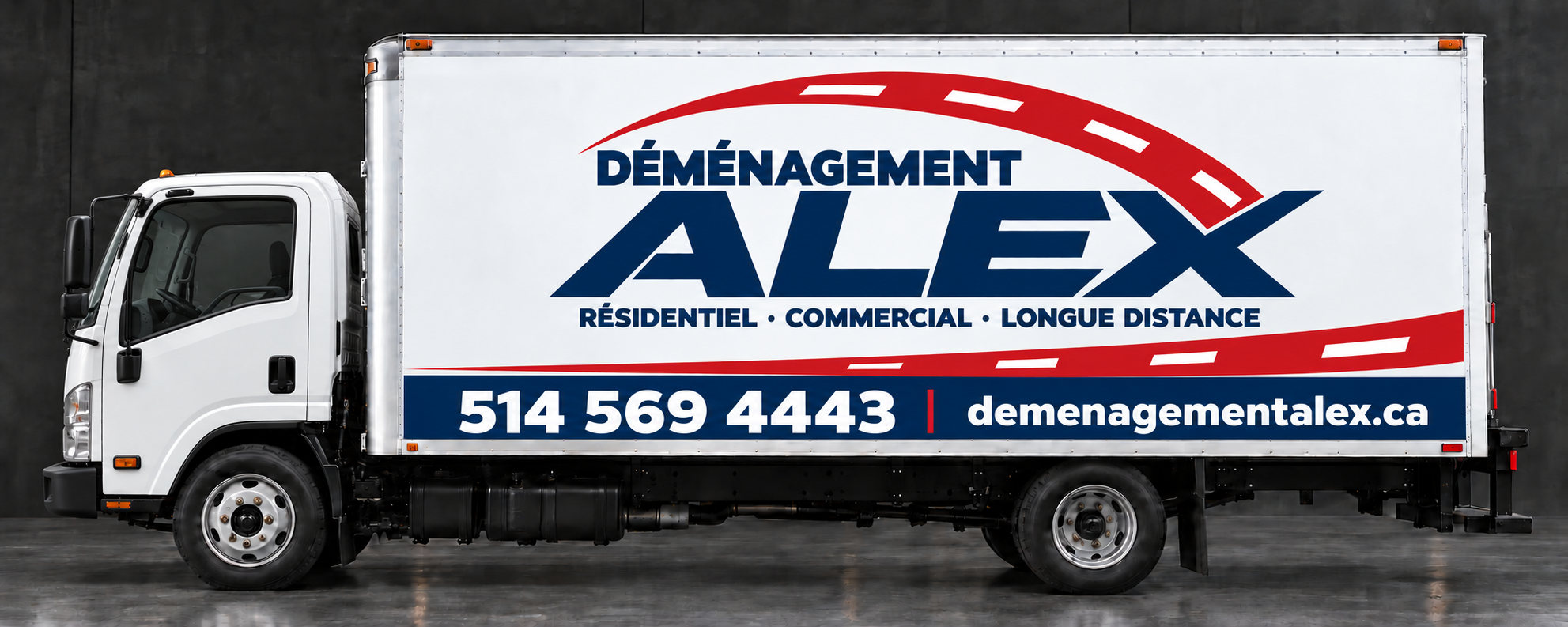 Independent concept study
One dominant name. One contact zone. Nothing competes with the call to action.
A shared visual rule stays intact across different vehicle proportions.
Every working vehicle is evidence of the company in the neighbourhood.
The prepress bridge
It is finished when the printer, material and installer all know exactly what to do with it. That bridge between the visual idea and a physical vehicle is where costly mistakes are prevented.
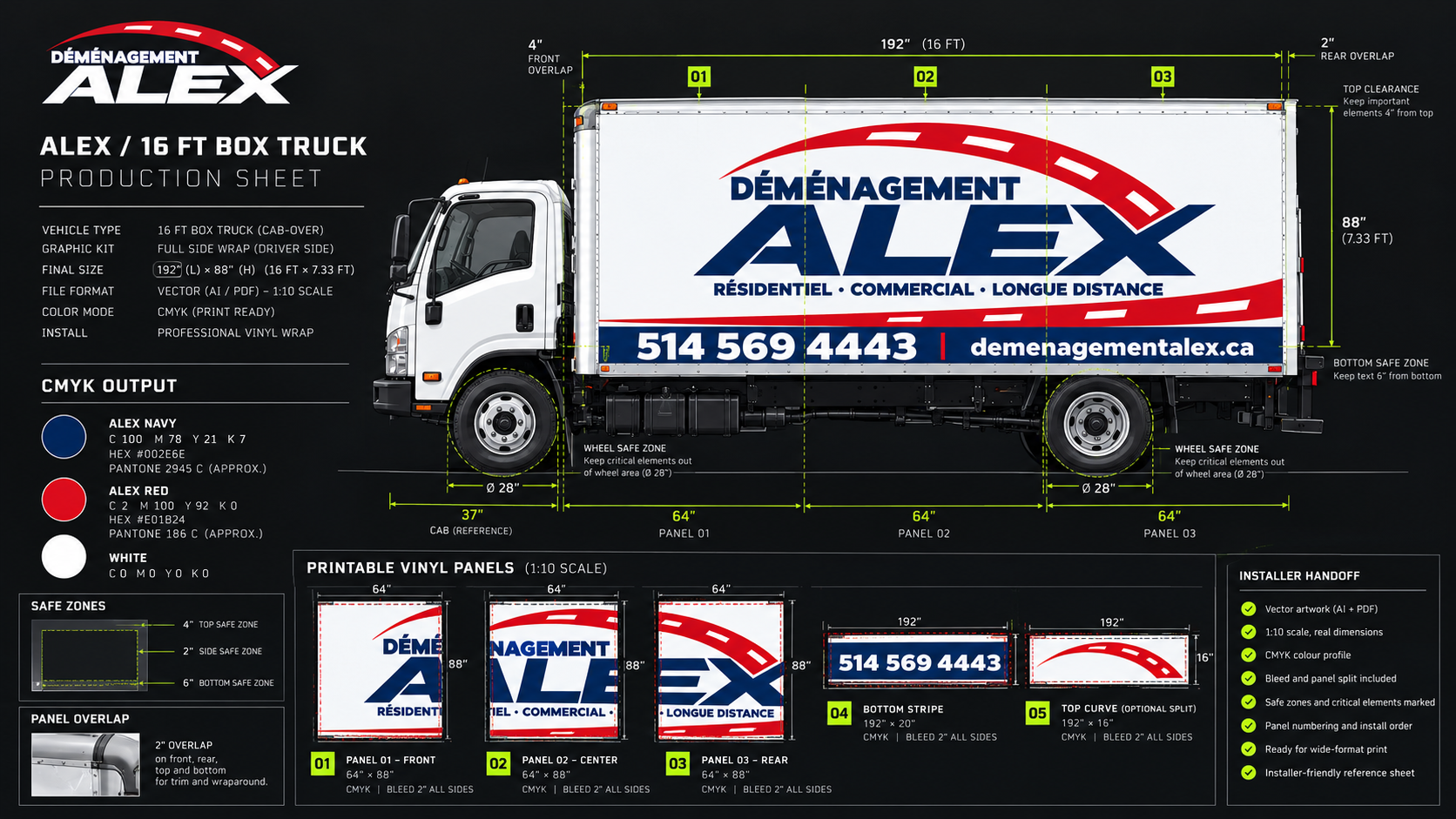
Work from the exact vehicle template — doors, handles, rivets, wheel arches and seams included.
Panel overlaps, bleed, cut paths and colour settings are chosen for the printer and film, not guessed in the artwork.
Print panels, placement notes and a final install map allow the right specialists to execute the same intent.
Print production / the rational path
A production cell is not a printer in a corner. Printer, film, laminate, colour settings, cutting, finishing and installation handoff need to work as one system.
Own the work that creates the value: design direction, vehicle templates, prepress, material specification and client coordination. Printing and installation can be delivered through carefully chosen specialists while we learn real volume, turnaround and margin.
Low fixed cost. Real workflow learning.Bring equipment inside only when repeat work makes quality control, lead time and material purchasing worth owning. The investment should remove a proven production bottleneck — not simply look impressive on a quote.
More control. Investment earned by demand.Most wrap films arrive in wide 54- or 60-inch rolls. A 64-inch printer gives room to run those materials with bleed and clean edge handling, reducing unnecessary joins on large side graphics. The real requirement is repeatable colour, approved media profiles and a take-up system — not just headline speed.
A matching overlaminate protects printed graphics from UV, abrasion, moisture, road grime and regular washing. Its width must match the printer so full-width work is not trimmed before protection. For pressure-sensitive vehicle films, even pressure, straight tracking and clean tension matter as much as the machine’s width.
A full-width cutter handles decals, door lettering and smaller fleet elements without becoming the next width restriction. Its price is separate from the supporting workflow: RIP licences, colour profiles, test prints, racks, tools, a finishing bench, materials and working capital all belong in the complete operating budget.
Full wraps, compound curves, recessed areas and riveted surfaces call for a premium cast print film with repositionable, air-release adhesive, paired with its compatible cast overlaminate. The point is not the most expensive brand; it is a film system that can conform cleanly and stay stable through the vehicle’s working life.
Calendared vinyl can still make sense on flat box-truck panels, simple temporary graphics or cost-sensitive short runs. The choice must be deliberate. Every job is specified as one tested system: printer and ink, approved profile, base film, overlaminate and installation method.
Directional Canadian planning references, checked 08 Oct 2026 — not supplier quotes. Examples: a current Roland VG3-640 listing, an HP Latex 630 promotion sheet, and 64-inch laminator reference, plus a 64-inch Graphtec cutter reference.
A measured launch
Use a real vehicle to test the workflow, documentation and client experience.
Package the offer around design, prepress and trusted production / installation relationships.
Turn individual jobs into a visual system that can be deployed vehicle after vehicle.
Invest only when volume, lead time and quality control prove it is the next logical move.
Where I fit
Five years across media and graphic design, plus hands-on production and digital experience, give me a useful role between the first idea and the final client-facing result.
Five years in media and graphic design, including flyers, banners and packaging. I work confidently in Photoshop and Illustrator, and understand how to prepare layouts, artwork and specifications for print.
I can build and maintain practical websites with HTML, CSS and JavaScript, and have worked with WordPress. I can also manage social channels, make photographs and shoot / edit video in Premiere Pro.
I have experience commissioning and tuning industrial production lines, working with sensors and controllers. That makes process, quality checks and repeatability part of how I approach a production workflow.
I can connect the visual system, print-ready files, production partners, website and marketing — so the customer sees one consistent brand instead of disconnected pieces.
The first real step
The ALEX study is not a promise of a finished rebrand. It is proof of the level of thinking we can bring to the first production project.
Return to the concept